
In contrast, the bottom five lack accountability, a total quality system and do not realise human potential.
Moore Squared Communications and The Maturity Institute today launch The Investment Credibility Index to look beyond the bottom line of UK institutional asset managers.
The Investment Credibility Index analyses how well the asset management sector values its human capital and creates total stakeholder value.
Stuart Woollard, co-founder of The Maturity Institute, says: “This index provides a helpful spotlight for asset managers – to highlight where they can realise human potential and how well or badly they are creating total stakeholder value.”
Charlotte Moore, co-founder of Moore Squared Communications, says: “Looking beyond the bottom line is increasingly important as asset-owners look for managers who align with their values.”
Natasha Moore, co-founder of Moore Squared Communications, says: “It’s understandable why asset managers focus on financial metrics but this does not capture how well these organisations manage their human capital which is the long-term driver of performance.”
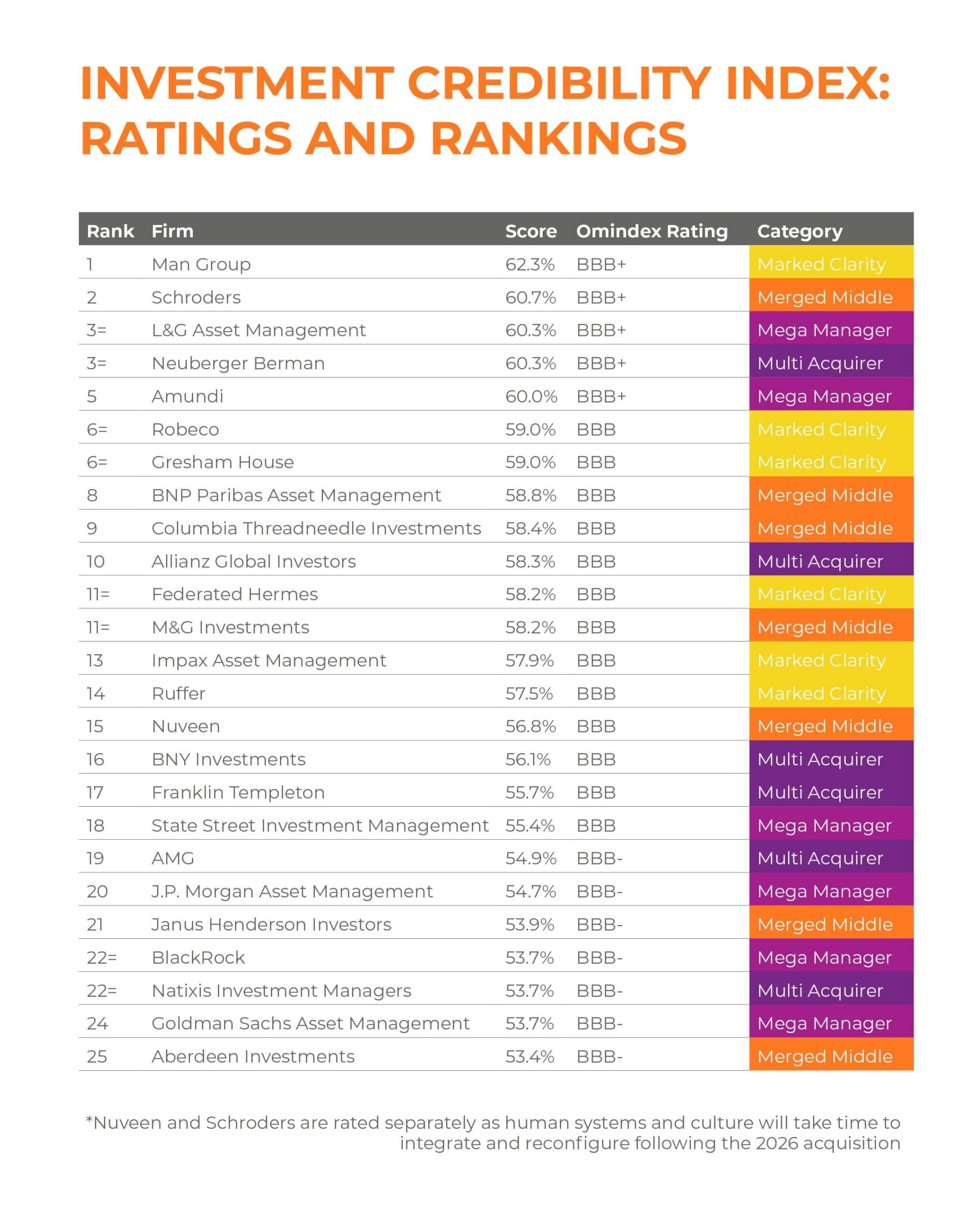
The index was created using a representative sample of 25 firms using The Maturity Institute’s 32 distinct characteristics. The rankings of these firms can be seen above.
What separates the top five from the bottom five?
The top five performers – Man Group, Schroders, L&G Asset Management, Neuberger Berman and Amundi – share the following characteristics:
- Adaptability
These firms can pivot their business strategy. This enables them to react to a changing business environment, staying ahead of their competitors and consistently meet evolving stakeholder need – particularly those of their clients. This is a particular strength given the rapid evolution in the UK institutional market. - Strong business model
All five organisations are defined and managed by a balanced set of variables encompassing assets under management, operating costs, revenues, quality and stakeholder impact. Each organisation has built a strong foundation on which to deliver total stakeholder value. In other words, these organisations are actively looking beyond the bottom line. - Authenticity
These asset managers score reasonably well on authenticity. This creates greater trust with stakeholders – especially clients – as these firms largely do what they say. But all five – and the wider index universe – would benefit from improving the consistency of their promises, narrowing the gap between rhetoric and reality as well as improving transparency.
Common characteristics of the bottom five – Janus Henderson, BlackRock, Natixis, Goldman Sachs Asset Management and Aberdeen – are:
- Lack of accountability
These five asset managers are more focused on financial value than the top five scorers. The top five have a more balanced business model which incorporates quality metrics and stakeholder value. Neglecting these values means the bottom five firms lack the mechanisms to improve stakeholder value. This negatively impacts their accountability because there is a lack of alignment with client need. - Failure to create a total quality system
These five companies do not demonstrate frameworks with which to operate a total quality system that goes beyond compliance and control. This is an important gap because they have not taken steps to ensure quality is at the heart of everything they do and they lack the systems to ensure consistent standards. - Failure to measure return on human investment
None of these organisations demonstrate any discipline or evidence for measuring and managing the return on human investment. This lack of human capital ROI means the organisations lack the framework to connect workforce investment to financial value creation.
The four Cs – what are they and why are they important
In the past, an asset manager’s success in the institutional market was all about making it onto the consultant buy list. But decades of change and an evolution of the sector mean asset managers need to be more focused on building long-term partnerships with their clients.
Moore Squared Communications has identified the four Cs needed for an asset manager to be seen as credible by asset owners – clarity, culture, communications and consistency.
What separates the top five asset managers from the bottom five on the four Cs?
Clarity
The asset managers at the top of The Investment Credibility Index have more clearly articulated their purpose, values and strategic goals.
They have also better defined the relationship between financial and stakeholder value to ensure staff are working to shared goals.
Lower ranked firms have conflicting priorities. There is one system targeting financial goals and another for values, principles and culture. The first usually takes precedence over the second.
Culture
The highest ranked companies have a strategic understanding of how culture drives stakeholder value and how it mitigates both operational and reputational risk. Lower ranked companies have not integrated financial performance with the human systems which drive it.
Communication
The best firms understand effective internal and external communication is essential to create value and growth. Those at the bottom are more likely to experience communication dysfunction and failures.
Consistency
The highest quality firms provide evidence their systems operate coherently. For example, remuneration has greater alignment with their purpose, strategy and value creation. The lowest ranked companies have structural, operational and cultural fragmentation. This is often a result of mergers and acquisitions.